


By: Zara Amoon
Every year, as winter loosens its grip and the first blossoms of spring begin to emerge, the city of Lahore, one of South Asia’s oldest and most vibrant cultural centers, traditionally thrums with the joyous spirit of Basant—a festival of colour, kite-flying, music, dance, and community celebration. Known for its breathtaking skies filled with kites of every possible hue and shape, Basant has been deeply intertwined with the cultural identity of Lahore and Punjab for generations. Though its recent history has been tumultuous due to safety concerns and official bans, 2026 marks a historic moment as the iconic festival returns to Lahore’s rooftops after more than a decade and a half.
Origins of Basant: From Ancient Spring Celebrations to Punjabi Tradition
The roots of Basant stretch deep into the cultural and agricultural rhythms of the Indian subcontinent. The word “Basant” (or “Vasant”) comes from Sanskrit, referring to the season of spring—a time of renewal, growth, and rebirth. Historically, the arrival of spring was celebrated with various rituals, songs, feasts, and observances across northern India and the greater Punjab region. One ancient analogue is Vasant Panchami, a Hindu festival that marks the fifth day (Panchami) of the lunar month dedicated to welcoming spring and honouring Saraswati, the goddess of wisdom, arts, and knowledge.
However, the Basant as it became known in Lahore developed its own unique character over centuries—particularly during and after the Mughal era. While early spring celebrations might have been rooted in agrarian rituals and religious customs, by the time of Lahore’s urban flowering under Mughal patronage, Basant had evolved into a public spectacle of colour and competition. The skies above Lahore Fort and the old city were filled with flying kites, and courts and gatherings celebrated love, music, poetry, and life’s renewal. Legendary poets such as Amir Khusrau celebrated Basant as a season of joy and an emblem of spiritual intoxication, symbolising the uplifting of the human spirit much like the rising of the sun on a spring morning.
Over the centuries, kite flying—which began as a playful pursuit—became central to Basant celebrations in the Punjabi urban milieu. Roofs of homes, especially in Lahore’s Walled City, became stages for spirited kite battles between neighbourhoods. “Lo kata”—the exclamation of triumph when one kite string severs another—echoed across alleys and rooftops as rival flyers competed for glory. Kites of all sizes and colours filled the cobalt sky, creating a mosaic of festive fervour that transformed the city into a living canvas.
Basant in Lahore’s Social and Cultural Life
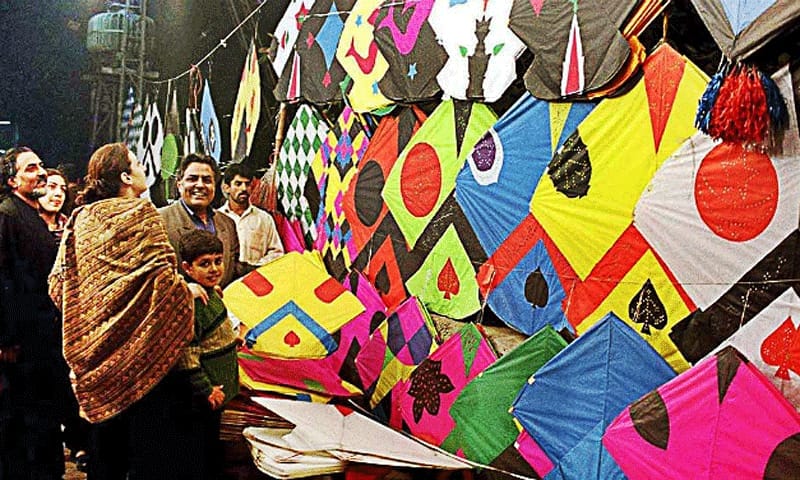
For Lahoris, Basant was never just a festival—it was a way of life. Streets buzzed with anticipation in the weeks leading up to the festival. Markets overflowed with kite sellers and craftsmen, offering everything from delicate paper kites to elaborate designs with bamboo frames and colourful tails. Manjha (kite string), traditionally coated with fine grit to make it sharp, became both a tool of competition and, in later years, a source of controversy due to safety concerns.
The festival was as much about food, music, and camaraderie as it was about kite flying. Families and friends gathered on rooftops for picnics and parties. Barbecue smoke danced in the cool air alongside the colourful threads of kites. Traditional Punjabi music—especially the beat of the dhol (double-headed drum)—set a rhythm that matched the city’s pulse, pulling participants away from everyday worries and into the collective celebration of spring’s promise.
The Basant spirit also extended into economic life. Artisans and kite makers enjoyed thriving business, food vendors made merry through the long festival nights, and communities opened their doors to visitors from across Pakistan and abroad. Basant was not confined to Lahore alone; neighbouring cities and towns in Punjab enjoyed their own versions of the festival, though none matched the scale or intensity of Lahore’s historic celebrations.
Basant’s Decline and Ban: A History of Risks and Restrictions
Despite its cultural richness, Basant’s rapid growth in the late 20th and early 21st centuries brought with it a darker side. The competitive zeal that drove kite battles spurred flyers to adopt increasingly hazardous materials for their strings—particularly metal, glass-coated, or chemically treated threads designed to cut competitors’ strings more effectively. These dangerous strings caused serious injuries and fatalities, especially among motorcyclists, pedestrians, and bystanders who were often unaware of the risks. Electrocutions, throat lacerations, and deaths became tragically common during Basant seasons.
Beyond the risks of string injuries, celebratory gunfire—another harmful Basant trope—contributed to public safety concerns. The combination of hazardous kite battles and careless celebratory practices eventually compelled authorities to act decisively. In 2005–2007, the provincial government in Punjab imposed a ban on kite flying and Basant celebrations, citing public safety and an alarming increase in injuries and deaths linked to the festival. Over the years, efforts to reinstate Basant met with resistance as safety risks and injuries continued to surface.
For nearly two decades, an entire generation of Lahore’s youth grew up without ever experiencing the kaleidoscopic skies of Basant in their city. Old photographs and family stories preserved memories of those years when rooftops were crowded with people shouting “Bo kata!” while colourful kites danced against the skyline. The absence of Basant left a palpable cultural void.
The Revival of Basant in 2026: Policies, Regulation, and Celebration
After nearly 18 years of effective prohibition, Basant made a historic return to Lahore in February 2026, thanks to new political will, legislative changes, and an emphasis on safety and regulation. The Punjab Regulation of Kite Flying Bill, 2025 (also referred to as the Punjab Kite Flying Ordinance, 2025) provided a legal framework to permit Basant celebrations with strict safety protocols to safeguard participants and bystanders.
Under the new ordinance, kite flying is permitted on specific days—February 6, 7, and 8, 2026—and confined to the Lahore district. Authorities worked with local administrators to register kite makers, sellers, and manufacturers and to implement QR-coded kites and strings to ensure traceability and compliance with regulations. Materials deemed unsafe—such as metallic or glass-coated strings—are banned outright, and sharp enforcement measures are in place to prevent violations.
To address past safety concerns, officials launched campaigns to install safety antennas on motorcycles across Lahore, aiming to reduce the risk of string injuries to riders. Rooftops and venues were inspected and approved only if they met structural and safety criteria. Loud music, fireworks, and other potentially risky Basant practices were restricted to minimize accidents and disturbances.
The provincial cabinet also emphasized citizen responsibility, urging communities to celebrate within the law and adhere strictly to safety guidelines. Buses and rickshaws were directed to offer free or subsidized rides to reduce motorcycle traffic during Basant days, acknowledging that motorcycles historically faced the greatest risk from stray strings.
Basant 2026: The Return of a Cultural Phenomenon
As the festival returned, Lahoris responded with enthusiasm and nostalgia. Kite shops buzzed with activity, selling thousands of kites and strings across the city. Rooftops—especially in central and historic neighbourhoods such as Mochi Gate and Rang Mahal—were booked months in advance at premium rates, decorated with lights and preparing food and refreshments for family gatherings and festivities.
Local markets experienced unprecedented sales as residents stocked up on kites, traditional foods, and decorative items. According to reports, Lahore saw record spending on Basant preparations, with hundreds of millions of Pakistani rupees circulating in the economy within the first days of the festival alone—testimony to the pent-up excitement and cultural longing for Basant’s return.
Despite safety regulations and legal constraints, the essence of Basant—the vibrant colours, the shared joy of kite flying, and the celebration of spring—remained intact. Families gathered on their rooftops as the late winter sun warmed the cool air, friends competed good-naturedly in lighthearted kite battles, and young Lahoris experienced Basant firsthand for the first time.
Basant’s Cultural Legacy and Contemporary Significance
Basant’s significance extends beyond kites. It represents Lahore’s cultural identity, its historical openness to joyous celebration, and its ability to meld tradition with modernity. Even as regulations temper some of the festival’s excesses, the 2026 revival illustrates that cultural heritage can be preserved responsibly. Rather than a return to the unregulated festivities of the past, Basant 2026 represents a negotiated celebration—one that honours history while prioritizing human life and safety.
For many Lahoris, Basant is more than an event: it is a symbol of community, belonging, and seasonal renewal. The festival’s phoenix-like return after decades of absence has rekindled inter-generational connections—grandparents sharing stories of past Basants, parents reliving youthful memories, and children discovering the festival’s magic for the first time. Viewers of colorful skies remember that Basant was never merely about flying a kite; it was about reaching for something higher—joy, community, shared identity, and the simple wonder of spring.
From ancient seasonal rites to a modern cultural phenomenon, Basant has endured as a defining feature of Lahore’s cultural landscape. Its trajectory—from celebratory zenith to controversial decline and now to regulated revival—reflects broader themes in South Asian cultural history: the interplay between tradition and safety, nostalgia and modern governance, and communal celebration and public responsibility.
The 2026 Basant festival stands as a landmark moment—one that showcases Lahore’s resilience, creativity, and desire to preserve its heritage in ways that both honour the past and protect the future. As kites once again fill the skies over Lahore, the spirit of Basant remains alive: radiant, colourful, communal, and soaring with hope.