


By: Nabila Feroz Bhatti
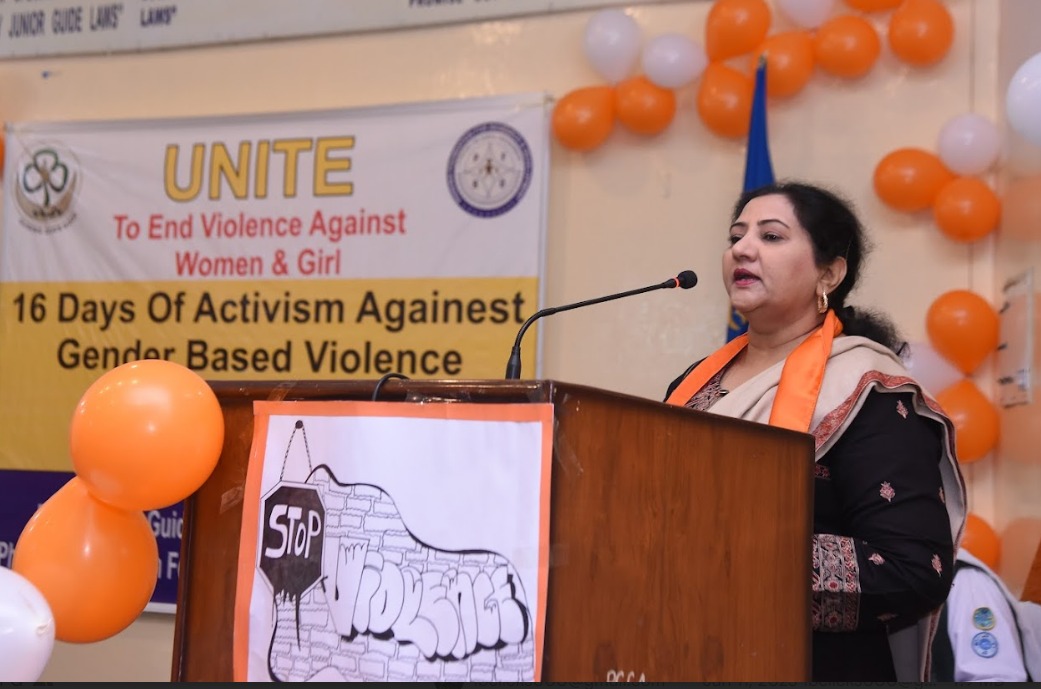
The 16 Days of Activism against Gender-Based Violence is an international campaign launched in 1991 to oppose violence against women and girls. It runs annually from November 25—the International Day for the Elimination of Violence against Women—to December 10, International Human Rights Day. The campaign urges individuals and communities worldwide to take action to end all forms of gender-based violence (GBV).
This year’s theme, “UNiTE to End Digital Violence against All Women and Girls,” focuses on digital abuse—now the fastest-growing form of violence. Increasingly, digital tools are being weaponized to stalk, harass, and abuse women and girls. These acts rarely remain confined to the online world; they often escalate into offline coercion, physical abuse, and even killings. The impact of digital violence can be severe and prolonged for survivors.
Digital violence disproportionately targets women across all sectors, especially those with public or online visibility—activists, journalists, politicians, human rights defenders, and young women. Its effects are worse for women facing multiple forms of discrimination, including on the basis of religion, race, disability, or gender identity.
The United Nations defines Violence Against Women as any act of gender-based violence resulting in, or likely to result in, physical, sexual, or psychological harm or suffering to women, including threats, coercion, or arbitrary deprivation of liberty, whether in public or private spaces. The term “women,” unless stated otherwise, includes girls of all ages.
International human rights frameworks—including the Universal Declaration of Human Rights, the UN Declaration on the Elimination of Violence against Women, the UNCRC, and CEDAW, to which Pakistan has long been a party—provide standards and obligations for eliminating VAW.
The UN’s Sustainable Development Goal 5, Gender Equality, also includes targets aimed at ending violence against women. Through UN Women, UNICEF, and other entities, the UN supports global and national initiatives to address GBV, promote gender equality, and tackle its root causes.
In Pakistan, Articles 25 and 34 of the Constitution affirm equality between men and women and provide a constitutional foundation for combating GBV. Federal and provincial legislation—including the Federal Domestic Violence (Prevention and Protection) Act 2020, the Punjab Protection of Women against Violence Act 2016, and the Protection of Women (Criminal Laws Amendment) Act 2006—offer legal protections.
Pakistan’s Prevention of Electronic Crimes Act (PECA) 2016 criminalizes digital offenses such as sexual threats, defamation, and non-consensual sharing of images or videos. However, civil society groups have expressed concerns over its implementation.
These laws provide mechanisms for punishment, prevention, protection, and rehabilitation—such as psycho-social support, legal aid, and shelters. But enforcement gaps, insufficient resources, and weak institutional coordination continue to undermine their effectiveness.
Reflecting this year’s theme, the Digital Rights Foundation (DRF) recorded 3,171 complaints of tech-facilitated GBV in 2024 alone, including 1,772 filed by women. Over eight years, its helpline has processed more than 20,000 cases, averaging 264 cases monthly. Yet under-reporting remains rampant; studies show that 65% of Pakistani women facing online harassment do not report it due to fear, shame, or mistrust of institutions.
The NCSW’s 2023 report, Digitalisation & Women in Pakistan, found that nearly 40% of surveyed women had experienced cyberbullying or harassment. Conviction rates remain extremely low—only 92 convictions out of 1,375 FIRs for cybercrime were secured in 2023, less than 4%, according to Federal Investigation Agency data.
A broader look at VAW reveals deeply concerning trends. The National Commission on the Status of Women estimates that 90% of women in Pakistan experience some form of domestic violence in their lifetime. Yet only 0.4% of cases reach the courts, and half of the victims never disclose their experience to anyone.
On November 7, Pakistan’s Minister for Human Rights informed the National Assembly that more than 7,500 women were killed between 2021 and 2024, including 1,553 honour killings.
The National Police Bureau recorded 173,367 VAW cases nationwide over four years, with numbers rising annually. These included 17,771 rape and gang-rape cases and nearly 10,000 cases of domestic brutality.
A 2024 report by the Sustainable Social Development Organisation documented 32,617 GBV cases in that year alone, including 5,339 rapes, 24,439 abductions, 2,238 incidents of domestic violence, and 547 honour killings.
According to UNICEF, 19 million girls in Pakistan are child brides. Some 4.8 million were married before age 15. Overall, 29% of girls marry before 18, and 4% before 15.
The National Commission on the Rights of Child highlights that abduction, forced conversion, and forced marriage of minor girls are especially concentrated in Sindh, which accounts for 69% of reported cases, followed by Punjab with 30%. Of these victims, 71% were under 18 and 22% under 14.
Despite thousands of cases annually, Pakistan’s conviction rate remains alarmingly low: 0.5% for rape and honour killings, 0.1% for kidnapping/abduction, and 1.3% for domestic violence. These figures point to systemic challenges including weak investigations, inadequate forensic capacity, social stigma, and judicial inefficiencies.
This year’s campaign underscores that digital safety is now essential to gender equality. Safe online participation for women requires digital literacy, awareness of legal rights, and reliable mechanisms to report and address digital abuse.
Ending digital violence demands collective responsibility. Governments must strengthen and enforce relevant laws; technology companies must ensure safer online spaces; and feminist and human rights organisations must intensify awareness and advocacy around digital GBV.
Individuals also play a critical role—speaking out against harmful online norms, supporting survivors, hosting digital safety sessions, and participating in male-allyship initiatives that challenge digital VAW.
At the community level, people can collaborate with organisations working to end VAW by volunteering, donating, or joining awareness campaigns. Advocacy with policymakers for stronger legal protections and better implementation is essential.
Listening to survivors with empathy, validating their experiences, and amplifying their voices helps break the silence surrounding VAW. Sharing stories on social media and displaying the colour orange—symbolising hope and a future free of violence—can help raise visibility.
Understanding the significance of the campaign, spreading awareness, supporting survivors, and advocating for systemic change all contribute to building a world where every woman can live free from violence. Collective action can help create an environment in which women enjoy all their rights without fear.
Nabila Feroz Bhatti is a human rights activist and columnist. She is a Member of the Working Group at the National Commission on the Rights of Child. She can be reached at [email protected] or on X: @NabilaFBhatti.