


News Desk
KARACHI, August 11, 2026:
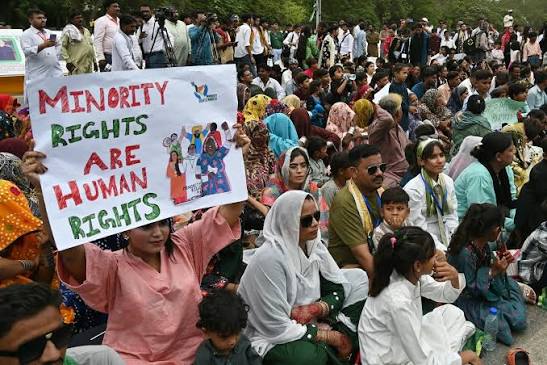
The Minority Rights March (MRM), along with civil society organisations and activists, observed National Minorities Day outside Mazar-e-Quaid in Karachi, calling for greater protection of religious minorities and reforms to ensure equal citizenship, said the press release
The participants referred to Muhammad Ali Jinnah’s August 11, 1947, address to Pakistan’s Constituent Assembly, arguing that the country’s founding vision of equal citizenship had yet to be fully realised.
Speakers and organisers highlighted what they described as increasing challenges faced by religious minorities, including targeted violence, attacks on and desecration of places of worship, alleged illegal occupation of minority properties, discrimination in education and employment, and cases involving the abduction, forced conversion and marriage of minority girls.
They also raised concerns over the alleged misuse of blasphemy laws to settle personal disputes, saying such practices had contributed to fear and insecurity among minority communities, particularly young people.
The MRM presented a set of demands to the state covering political representation, education, employment, religious freedom, minority property and institutional protection, and reforms to laws affecting religious minorities.
Among its education-related demands, the group called for the de-nationalisation of educational institutions belonging to religious minorities and a minimum 10 percent quota for minorities in public and private educational institutions at all academic levels, in addition to merit-based admissions and other existing quotas or scholarships.
The group also called for curriculum and textbook reforms to remove discriminatory or hate-based content and promote pluralism, religious diversity, peace and tolerance. It urged that religious instruction be limited to a subject relating to each faith and taught by qualified members of the respective faith communities. It further demanded that Jinnah’s August 11 speech be included in educational curricula.
On constitutional and political matters, the MRM called for amendments to replace the generic term “non-Muslim” with language recognising the specific religious identities of minority communities. It also proposed amendments to Articles 41 and 91 of the Constitution to make the offices of president and prime minister accessible to members of religious minorities on merit.
The organisation sought greater political representation through increased reserved seats in federal, provincial and local governments, as well as stronger minority participation in political parties. It proposed that political parties be required to field minority candidates on general seats and called for changes to the electoral system, including dual voting rights for minorities in elections to reserved seats.
The MRM further called for legislation criminalising forced or involuntary conversion and the establishment of dedicated shelter homes for members of religious minority communities facing threats or violence.
It also demanded reforms to the personal laws of religious minorities to protect the matrimonial, financial, inheritance and other legal rights of minority spouses and children in interfaith marriages.
Regarding blasphemy laws, the group called for an independent judicial commission to investigate allegations of misuse and urged authorities to ensure due process, protection of accused persons and action against individuals or groups attempting to influence legal proceedings through threats or violence.
The demands also included a minimum 10 percent minority employment quota across public and private institutions, measures to facilitate access to official documentation and domiciles, and an end to what the group described as discriminatory concentration of minorities in sanitation and menial jobs.
On property rights, the MRM called for protection of minority-owned communal property, places of worship and educational institutions from illegal occupation. It also demanded the return, restoration and repair of properties that had allegedly been seized or desecrated, along with digitisation of ownership records.
The participants called for implementation of the Supreme Court’s 2014 judgment concerning minority rights and the establishment of independent, autonomous and empowered national and provincial commissions for minorities.
The group also urged the government to promote inclusion by officially recognising minority religious festivals and ensuring employees can take holidays for such occasions. It called on educational institutions to avoid scheduling examinations for minority students during their religious festivals.
The organisers said the march was intended to reaffirm the demand for a Pakistan in which religious identity does not determine a citizen’s access to rights, opportunities, justice or public institutions.
The participants concluded by calling for a more inclusive and pluralistic Pakistan in which constitutional equality and the protection of religious minorities are reflected in law, policy and practice.